- A 4-room flat usually needs 22 to 30 downlights, not the 40-plus a ceiling plan often shows.
- Light in layers: ambient, task, accent. A room with only ambient light feels like an office.
- 3000K almost everywhere in a Singapore home. 4000K in the kitchen work zone if you cook seriously.
- Tunable white earns its cost in the bedroom and living room, and nowhere else.
- A magnetic track replaces six to eight downlights in a living room and lets you move light later.
Prices, measurements and counts in this guide are ELEVATED's own, recorded across our Singapore projects in 2026. They are not industry averages, and prices are ranges we review quarterly.
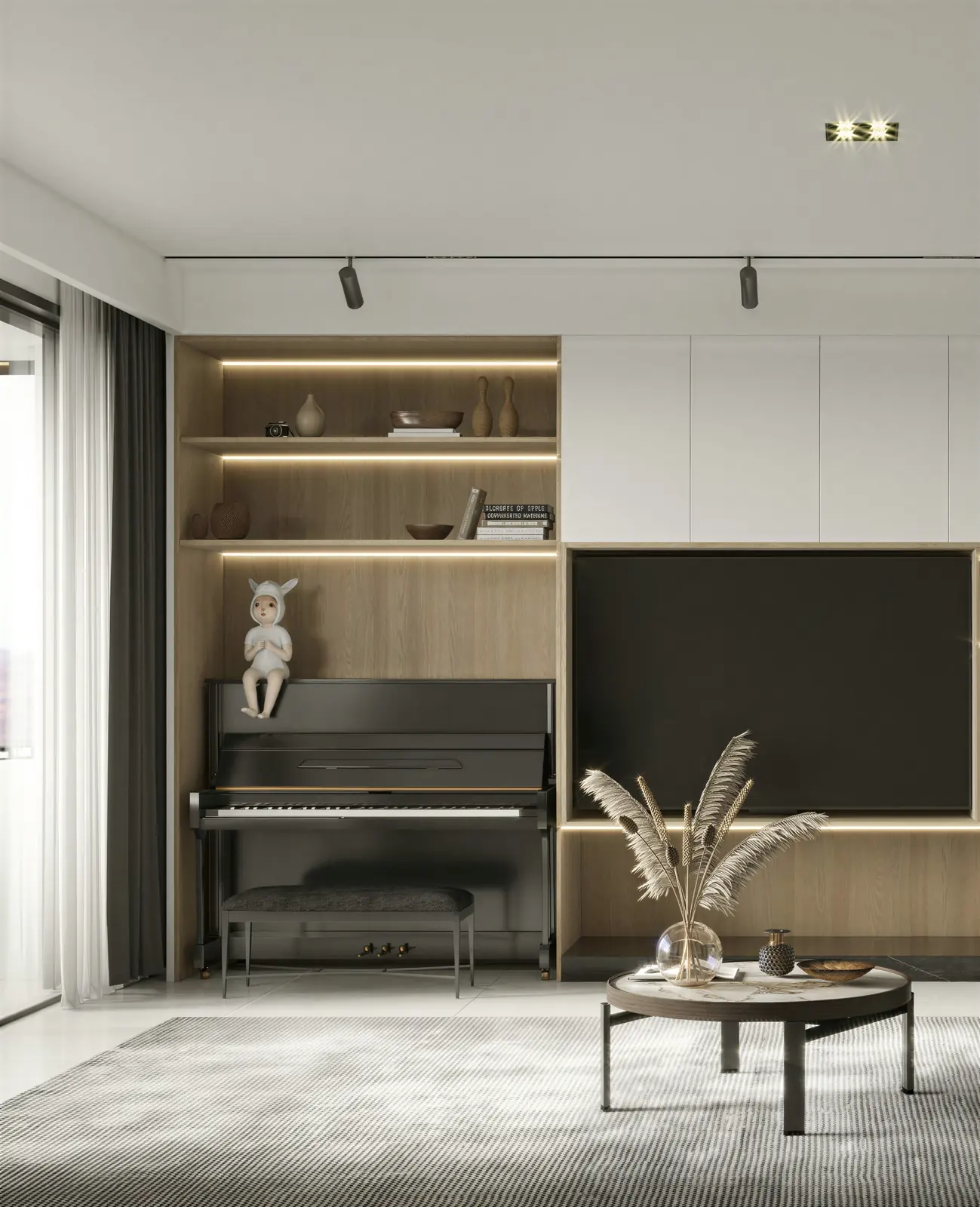
A four-room flat needs roughly 22 to 30 downlights. Ceiling plans routinely show forty or more, because a grid is easier to draw than a decision. The number falls once you decide what each light is for: general light for moving around, task light for work surfaces, and accent light for the things you want noticed. Below is how we lay out a typical four-room plan.
1. How many downlights does each zone need?
Working numbers from our own projects, for a standard four-room layout of about 90 sqm:
- Living and dining, 30 sqm — 8 to 10 downlights, plus a track or pendant over the dining table. Not 16.
- Kitchen, 8 sqm — 4 downlights plus a continuous strip under the wall cabinets. The strip does most of the useful work.
- Master bedroom, 12 sqm — 4 downlights placed away from the bed, plus bedside light. Never a downlight directly above where you lie.
- Bedroom 2 and 3, 9 sqm each — 3 to 4 each.
- Bathrooms — 2 each plus a dedicated mirror light. A ceiling downlight behind you puts your face in shadow.
- Corridor, entry, service yard — 1 to 3 total, on a sensor rather than a switch.
2. Which colour temperature suits each room?
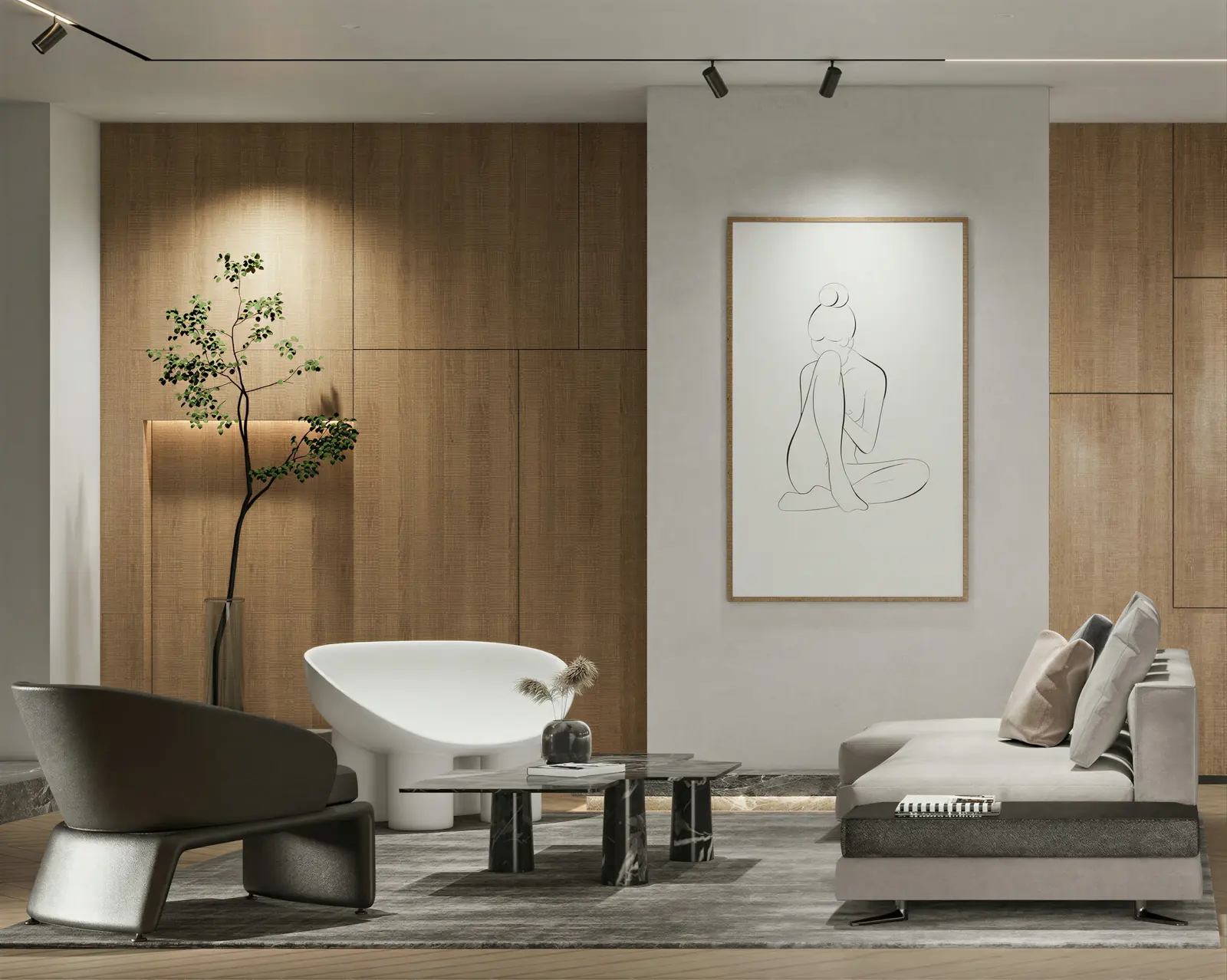
Singapore homes get this wrong in the same direction every time: too cool. Daylight-white ceilings at 6000K make a living room feel like a clinic at 9pm.
- Living, dining, bedrooms, corridor — 3000K. Warm without being yellow.
- Kitchen work surface — 4000K if you cook seriously, otherwise 3000K to match.
- Bathroom mirror — 3500K to 4000K. Makeup and shaving need neutral light.
- Service yard — 4000K. It is a utility space.
Whatever you choose, keep it consistent within sight lines. Two different temperatures visible at once is more noticeable than either one being slightly wrong.
3. Is tunable white worth the money?
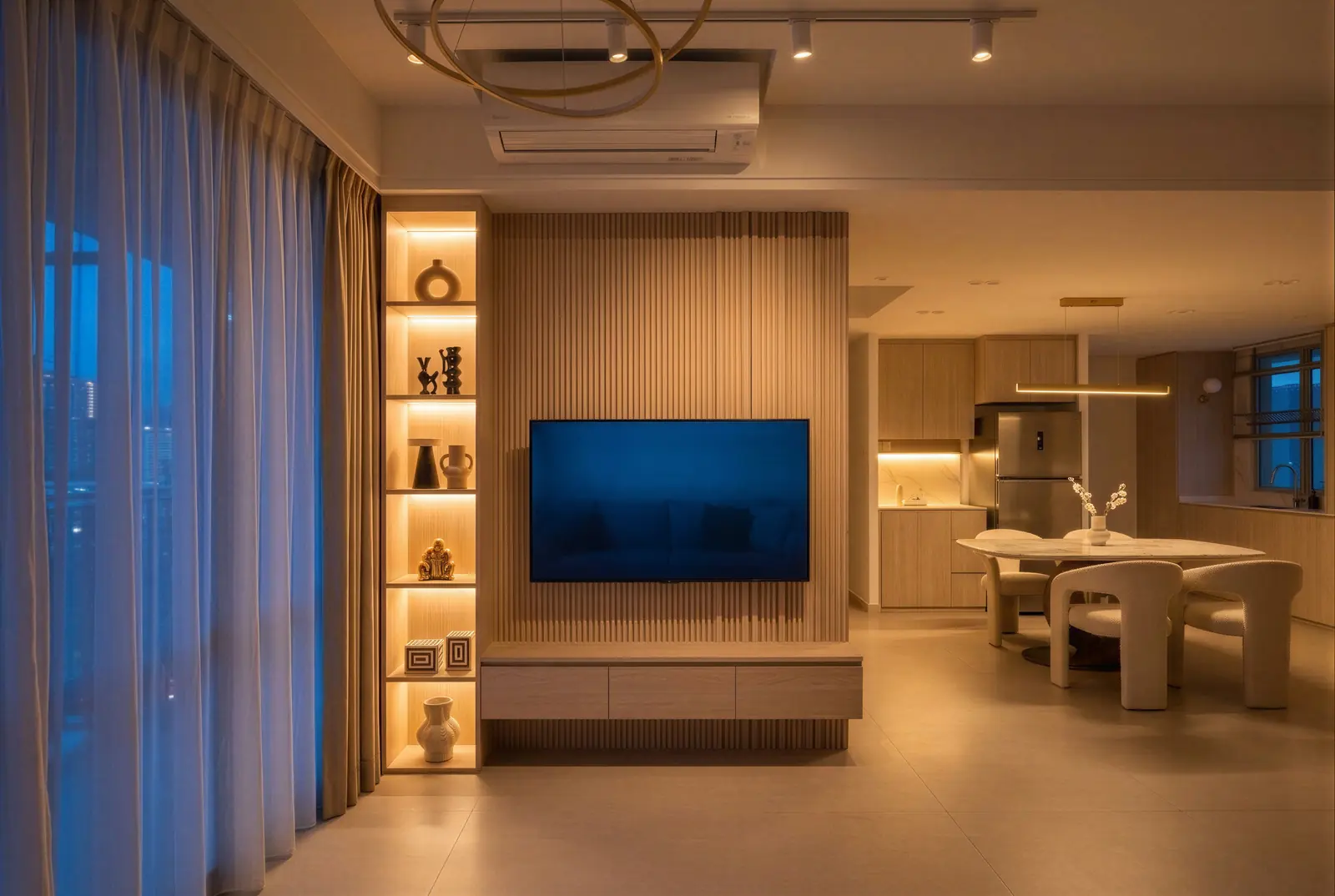
Tunable white lets a fitting shift between warm and cool. It costs roughly 40 to 70 percent more per point than fixed. It earns that in two places: the bedroom, where a 2700K evening setting genuinely helps winding down, and the living room, where the same ceiling serves a bright afternoon and a dim film night. Everywhere else, buy fixed 3000K and spend the difference on better fittings or more circuits.
4. Why do circuits matter more than dimmers?
A common disappointment: every downlight in the living room on one dimmable circuit. You can make it dim, but you cannot light the sofa without lighting the dining table. Split the living and dining ceiling into at least three circuits — perimeter, centre, dining — before worrying about dimming. Three plain circuits beat one dimmed circuit in daily use.
This is an electrical-stage decision and cannot be changed later without opening the ceiling.
5. When does a track beat downlights?
A magnetic track recessed into the false ceiling carries spots, linear elements and pendants on the same rail, and they can be moved afterwards. In a living room a 1.5 to 2 m run typically replaces six to eight downlights. Two reasons to choose it:
- You do not yet know where the sofa and the art will end up.
- You want accent light on a feature wall without committing to fixed positions.
Our own Rail range is a magnetic track; the reason we use one at all is that it is the only ceiling decision that stays adjustable after the plaster is closed.
6. Which three lights do people forget?
- Under the wall cabinets in the kitchen. Without it you work in your own shadow. A continuous strip, on its own switch.
- Inside the wardrobe. A strip with a door sensor. Cheap at carpentry stage, impossible afterwards.
- A low night light in the corridor. Twenty percent brightness on a presence sensor between 11pm and 6am, so nobody turns on a 3000K ceiling at 3am.
7. How do you make lighting smart without making it fragile?
Two ways to control smart lighting, and the difference matters:
- Smart switch, ordinary fittings. The switch controls the circuit. Cheaper, robust, and the fittings can be anything. Dimming depends on the driver being compatible.
- Smart fittings, ordinary switch left permanently on. Per-fitting colour and brightness, but the wall switch becomes a trap: turn it off and the fittings vanish from the system.
We default to smart switches on most circuits and smart fittings only where per-fitting colour actually earns it — usually the living room track and the bedroom. Whichever you choose, every room keeps a physical switch that does the obvious thing.
8. Where do sensors belong, and where are they a mistake?
Presence sensors belong in the corridor, the bathroom, the service yard and the wardrobe. They do not belong in the living room, where you sit still and the lights go off, or in the bedroom, where they turn on at the wrong moment. Use mmWave presence rather than PIR motion anywhere someone sits, and give every sensor-driven light a switch that overrides it.
See this in a finished home
Tampines, an executive condominium — photographs, the device list and what was decided on site. All projects.
Sources
Checkable references for the rules and standards cited above.
- Energy Market Authority — electrical installation and safety
- Connectivity Standards Alliance — the Matter standard
Questions people ask
How many downlights does a 4-room HDB need?
Typically 22 to 30 across the whole flat, laid out by zone rather than as an even grid. Plans showing forty or more are usually a grid rather than a design.
What colour temperature is best for a Singapore home?
3000K in living areas, dining, bedrooms and corridors. 4000K only in the kitchen work zone and service yard, and 3500K to 4000K at a bathroom mirror.
Is tunable white worth it?
In the bedroom and living room, usually yes. Elsewhere it costs 40 to 70 percent more per point for a feature that goes unused. Buy fixed 3000K and spend the difference on circuits.
Should I use smart bulbs or smart switches?
Smart switches for most circuits, because they survive someone turning the wall switch off. Smart fittings where per-fitting colour genuinely matters, usually the living room and bedroom.
Can I add track lighting after renovation?
A surface-mounted track, yes. A recessed magnetic track needs a channel formed in the false ceiling, so it has to be decided before the ceiling is closed.
Where should downlights go in a bedroom?
Away from the bed. Light directly above where you lie is uncomfortable to look at. We place them toward the wardrobe and the walking route, with separate bedside light for reading.
Tell us about your space.
Send your floor plan on WhatsApp. We reply with questions first, then drawings and a line-by-line quote.
WhatsApp us · +65 8897 9983